How to Buy Good Running Shoes
... for the Beginner Runner
Buying good running shoes is the first step for beginners and veteran runners alike. It's probably the single most important thing you can do before starting any beginner running exercise program.
-And it really doesn't matter if they're for running a marathon or just your daily treadmill running at home or at the gym.
The footwear you choose to wear can really make or break your entire running fitness program.
If you really want to get the full running health benefits, it's important that your feet are comfortable and in optimal running position .
-If overpronation (flat feet) or underpronation (high arch) is a problem for you, this really needs to be known before you make your purchase. (see the examples and video below)
Many don't even consider this and pay the price later with sore feet, blisters, or at the very least premature wear on expensive running shoes.
What's your foot type?-The wrong shoes could mean sore feet or knee pain from running
....and ultimately quitting before you even get started.
Good running shoes will provide comfort and cushioning for your feet,
In a nutshell, the right pair of shoes are worth their weight in gold.
-How to choose running shoes can be a daunting task. There are just so many models to choose from, not to mention the endless brands.
Advice on good running shoes, and which are the best can be confusing.
Do you an Overpronate?
To choose the best running shoes for you, it's important to know what type of foot you have in order to make the proper footwear choice. Choose good running shoes with one of these three basic foot types in mind:
-Foot Types: low arch (flat foot), high arch and normal arch.
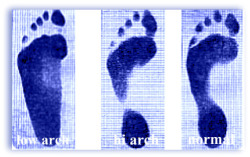
Although not a precise test, some people use the wet footprint test to determine your foot type.
This test involves wetting the bottom of your foot and standing on paper bag to make a footprint. Some shoe stores have similar tests using special paper, minus the water, to take the imprint.
-If the footprint is basically the same size as the foot, (far right above) it is said to represent a low arch or flat foot , and is thus an overpronated foot type.
-People with footprints with a very narrow outside curved shape are said to represent high arches or an underpronated foot type.
Footprints with a somewhat wider and less curved shape are said to represent a medium arch or neutral pronation .
* These are generalizations and it is possible to have flat feet and not be overpronating if this test is done with the foot at rest and not in running motion. (see pronation illustration or video below)
____________________
Those of us with low arches, also known as flat feet, usually (but not always) run on the inside of the foot, called over-pronating. ( Pronation refers to the rotational movement of the foot during walking and running for proper weight distribution)
-Because too much weight is put on the toe side of the foot during overpronation your weight is not evenly distributed, and the body does not absorb the shock as efficiently. This can lead to foot and leg injuries.
People who overpronate tend to wear down their running shoes on the inside of the shoe, toward the big toe. -When choosing a walking or running shoe, a person who overpronates should choose shoes with good inside support, usually with strong material at the inside sole and arch of the shoe.
Gel types are great for over-pronators and are quite popular.
-Shoes that feature motion control and stability in their names would be a good choice for runners with this type of foot. Stiffer shoes also help support overpronation because they prevent the foot from rolling inwards as it progresses from heel to toe during running motion.
A normal arch , or neutral pronation is the ideal and most efficient type of pace when using a heel strike that most of us use, as the entire body helps absorb the shock generated during running.
-A good fit and normal cushioning should be all that's needed. But, if you do a lot of running exercise, it's a good idea to have at least 2 pairs of good running shoes, to allow for drying time and a longer shoe life to boot.
If you have a high arch , chances are pretty good you run on the outside of your foot, called under-pronating . Those of us who are even slightly bow-legged also tend to underpronate, as the foot rolls outwards as we run.
A person who tends to wear down their running shoes on the outer edge and towards the back of the shoe.
-They'll need to look for a flexible sneaker with a soft mid-sole to act as a shock absorber for the body. -Look for the words flexible or extra-cushioned in the sneakers name when shopping for a high-arched foot.
Pronation Path

The illustration shows the path from heel to toe of the 3 foot types.
(Courtesy of wikimedia)
Once you've decided what kind of running you'll be doing, and what type of foot you're shopping for, there's just a few more buying tips to consider.
back to foot types|
How to Buy Running Shoes - part 2 Okay, you know what your foot type is, and the kind of running you're planning on doing: 1. -Many people use orthotics or special insoles in their running shoes, if this sounds like you, be sure to bring them with you to try on with the new shoes, and also that the new shoes have insoles that are removable. (many are, some are not) 2. -The heel bed is very important, it should be a good fit, nice and snug with no rubbing and slipping around, this is where the blisters often come from. 3. -There should be plenty of room in the front of the shoe for the toes to move, and you should have a full thumbnail between your biggest toe (not always the big toe) and the tip of the shoe. 4. -The width and height of the shoe should fit snug, but comfortable without any unnecessary movement of the foot from side to side or slipping. 5. -Don't make the mistake of buying what you think are the best looking shoes. You want good running shoes, sure you want to look good and be in style, but the overall fit has to be much more important to you. 6. -Have the salesperson measure both feet (they can be different) and give you their recommendations, a good store can really be of help, if for no other reason than they know which shoes are giving people problems, being returned, etc. (some have returns available at discount) 7. -Try on various brands and models. Don't always assume certain brands or styles will always be good running shoes for you, methods of construction change and are sometimes modified. -Different manufacturers always have at least slight differences, not always noticeable on visual inspection. Some styles run bigger or smaller, wider etc. 8. -Make sure to try them on at the end of the day when your feet are tired and likely to be puffier, and also be sure to wear socks that are similar to those you'll be running in. 9. -Lace them up and take a good hike (or jog) around the store, paying special attention to any rubbing or slipping. 10. -Your shoes should fit well, flex and feel good right from the start, they may not be quite ready for that big race, but no major softening up or break-in time should be needed, if they don't feel just right - 11. - Regardless of where you eventually do buy your shoes, the decision should be based on your personal arch type, your foot mechanics, past injuries, your preferred brands etc. (and NOT just the best looking!) -And, if you have had foot problems in the past, it's a good idea to seek out the help of those who know feet best. Whether it’s a professional at your local running or shoe store, or even a podiatrist in some cases. |
What is Pronation?
Can Cheap Shoes Be Good Running Shoes?
If price is a serious consideration, some dealers actually sell used running gear, as well as online at ebay. Also, many shoes are returned because of improper fit or type, and can oftentimes be purchased at a real bargain.
-Most good running shoe stores will let you return shoes if they've only been worn a little bit on a treadmill, (ask to be sure) so consider breaking them in with a bit of indoor running before you hit the streets.
If you're buying online, be sure of the dealers return policy before you buy, or you may be stuck with a pair of not so good running shoes.
-Finally, if you're really a dedicated runner, read the running shoe reviews. Asics Gel receives good reviews every year from the major running magazines as does Adidas and Brooks.
Make sure to try a few of the well-reviewed shoes on, assuming they're designed for your foot type and the price range is acceptable.
-If you're a beginner runner and not sure yet if running is your sport of choice, it still makes a lot of sense to get good running shoes.
If you need more info:
read this article by a certified athletic trainer and his views on choosing athletic shoes.
-If your feet feel good, you'll choose the right sport -and your legs, knees, muscles and, oh yeah ....your feet will thank you too!
Top
Back to Health Benefits of Running
| -Additional Information on Running and Your Health... |

Copyright © 2008-2023 - Health-Stories.org - All Rights Reserved For Informational Purposes Only, Not Intended As A Medical Advice Substitute. Advertising Disclosure~Privacy Policy~Disclaimer

" Digital Millennium Copyright Act" Service

Popular Stories Articles and Your Submissions


-
Fat Gram Chart
The fat gram chart shows you the calories needed to maintain a certain weight at various fat gram levels. As a fat loss guide you find the daily fat gram allowance for you.... -
The Top Ten Healthiest Foods
 What are the healthiest foods you should be eating? If you're searching for the secret to heart healthy eating and building a healthier body, our top ten will definitely get you there.
 -
Alzheimers Diagnosis
If you or a loved one is concerned about getting an Alzheimers diagnosis, it’s important for your doctor to rule everything else out. Alzheimers research continues, progress is being made every day... -
How to Prevent Flu and its Symptoms
To Prevent Flu and its many symptoms, whether from the newest seasonal flu strain, Swine flu (H1N1), or even just the common cold, there are many natural flu preventatives. -
Barefoot Running - Is it For You?
Running Barefoot? Zola Budd made barefoot running famous by breaking the women's 5000-meter world record in 1984 ...running barefoot. A few of the pros and cons. -
Health Benefits of Drinking Water
Consider the many health benefits of drinking water: a simple, inexpensive and effective way to lose weight, improve your overall health, and to help prevent symptoms of dehydration.
-Have you ever completed the Cooper Test Run? Let us know your results, or see how far others have run it, in their Cooper test, you just might be in for a surprise.
- Do you have a good tip for burning calories? Share it!
-Or check out these calorie burning tips left by our visitors.
Popular Running Pages :
-By subscribing to our blog
(don't worry no email needed)
-You'll get all the latest stories, articles and health tips as soon as they arrive.
-You'll also find your latest post ...right on the spot!
